

PEO Claims Advocacy Programs Help Employees Navigate Insurance Denials and Billing Disputes

PEO claims advocates review medical claim denials, negotiate facility bills, and connect employees to patient assistance programs, with industry denial rates averaging 17 percent across marketplace plans.

Step-by-step overview of the PEO claims advocacy process, from denial review and documentation through appeal submission and outcome tracking.
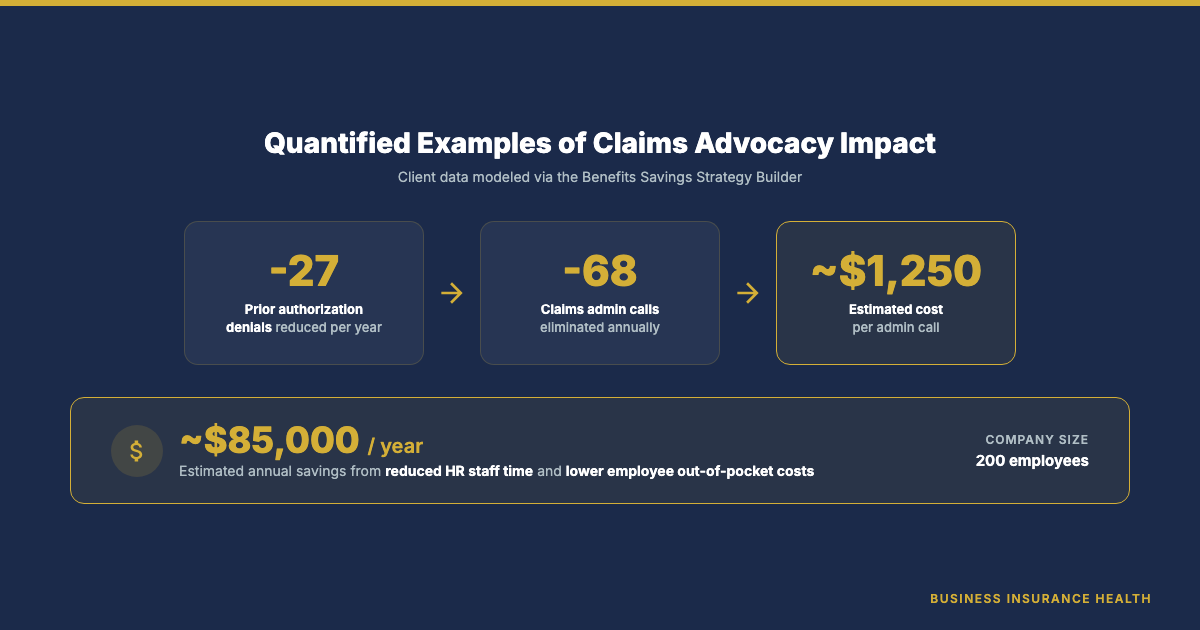
Example from client data showing how a reduction in prior authorization denials correlates with fewer claims administration calls and approximately $85,000 in estimated annual savings.
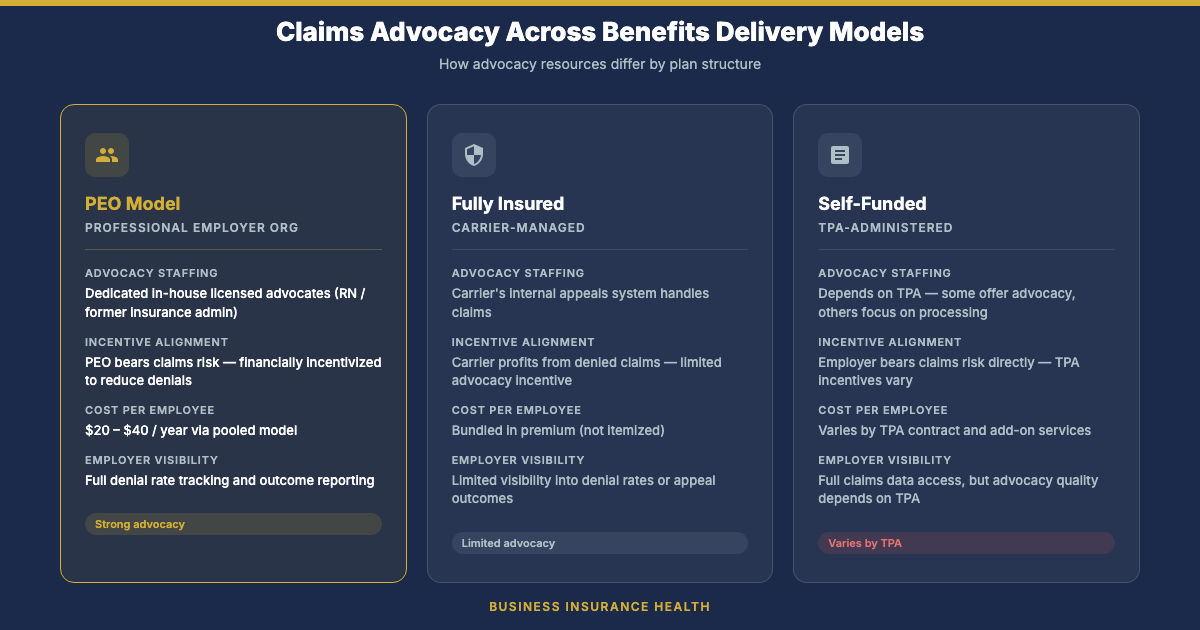
Comparison of how claims advocacy is typically handled across PEO, fully insured, and self-funded benefits delivery models, including staffing structure and incentive alignment.
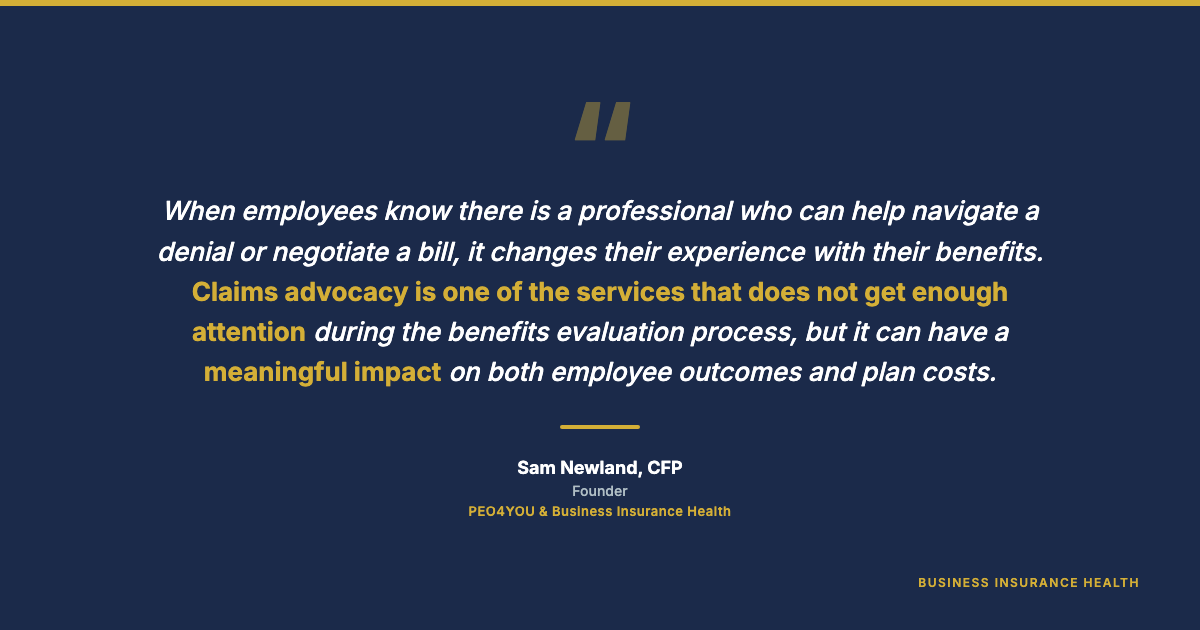
Sam Newland, CFP, founder of PEO4YOU and Business Insurance Health, on the role of claims advocacy in the benefits evaluation process.
Dedicated claims advocates employed by PEOs review medical denials, negotiate facility bills, and connect employees to assistance programs
BOSTON, MA, UNITED STATES, April 6, 2026 /EINPresswire.com/ -- Professional Employer Organizations (PEOs) that provide health benefits to client companies increasingly staff dedicated claims advocates — licensed professionals who review medical claim denials, negotiate facility bills, and help employees access patient assistance programs. As claims denial rates and medical billing complexity continue to rise, these advocacy services are drawing attention from employers evaluating benefits delivery models, including PEO arrangements (https://businessinsurance.health/peo-service/).
Industry Context
Medical claim denials have become a growing challenge across the U.S. health insurance landscape. According to a 2023 KFF analysis of Affordable Care Act marketplace plans, insurers denied approximately 17 percent of in-network claims on average, with some insurers denying more than 30 percent. Research published in Health Affairs found — as detailed in a recent analysis of health plan claims denial rates (https://businessinsurance.health/health-plan-claims-denial-rates/) — that fewer than one percent of denied claims are formally appealed by patients, yet when appeals are filed, the overturn rate ranges from 40 to 60 percent depending on the insurer and denial type.
At the same time, medical billing complexity has increased. A 2022 JAMA study found that roughly 80 percent of medical bills contain errors, ranging from duplicate charges to incorrect procedure codes. For employees, navigating denials and billing disputes requires knowledge of insurance regulations, appeals procedures, and market-rate pricing data that most individuals do not have. These trends have created demand for advocacy services that can bridge the gap between employees and insurance administration.
How Claims Advocacy Works Within a PEO
A claims advocate at a PEO is typically a licensed professional — often a registered nurse or former insurance administrator — who specializes in the insurance appeals process. When an employee receives a claim denial, the advocate reviews the denial reason, evaluates whether it was issued in error or at the edge of policy coverage, and determines whether an appeal is warranted.
If the advocate identifies grounds for appeal, they prepare documentation citing applicable regulations and medical evidence, then submit the appeal on behalf of the employee. Because advocates handle a high volume of cases across the PEO's client base, they develop familiarity with common denial patterns, insurer-specific appeal requirements, and regulatory frameworks that individual employees are unlikely to have.
Beyond individual appeals, claims advocates also identify systemic patterns. For example, an advocate may observe that prior authorization denials are occurring at an elevated rate across a particular plan and propose process changes or copay assistance programs to reduce future denials. Advocates may also identify high-cost claimants early and connect them to disease management, mental health services, or patient assistance programs.
When an employee faces a catastrophic diagnosis — such as cancer, an organ transplant, or a serious accident — an advocate can help navigate treatment options, locate in-network specialists, coordinate care across providers, and identify financial assistance programs that the employee may not be aware of.
Quantified Examples of Claims Advocacy Impact
Business Insurance Health's Benefits Savings Strategy Builder (https://businessinsurance.health/Benefits-Savings-Strategy-Builder/) models specific cost metrics associated with benefits coordinator and claims advocacy strategies. One example from client data: a reduction of 27 prior authorization denials per year correlated with 68 fewer claims administration calls, at an estimated savings of approximately $1,250 per call, totaling approximately $85,000 per year.
These figures reflect a combination of reduced HR staff time spent on claims-related calls and reduced out-of-pocket costs for employees whose denials were successfully appealed or prevented. Across a 200-person company over a full year, proactive claims advocacy may produce measurable cost reductions for both the employer and employees.
Claims advocates also review facility billing. In cases where a hospital charges significantly above market rate for a procedure — for example, $50,000 for a surgery with a regional average closer to $25,000 — the advocate may dispute the charge, cite comparable market rates, and negotiate a reduction. When successful, these negotiations reduce costs for the plan and can lower future renewal premiums.
Why PEOs Staff Claims Advocates
PEOs are able to employ dedicated claims advocates in part because of scale. A large PEO covering hundreds of thousands of employees can spread the cost of advocacy staff across many plans, resulting in an estimated cost per employee of $20 to $40 per year. An individual employer with 50 employees would typically find it impractical to hire a full-time advocate, but the pooled model makes it economically viable.
Incentive alignment also plays a role. In a PEO arrangement, the organization often bears some claims risk or manages benefits administration in a way that ties its financial performance to claims outcomes. This creates a structural incentive to invest in claims advocacy, employee wellness, disease management, and billing optimization.
Other benefits delivery models handle claims administration differently. In fully insured plans, the insurance carrier processes claims and handles appeals through its own internal systems. Employers on these plans may have limited visibility into denial rates or appeal outcomes. In self-funded arrangements, employers bear the claims risk directly and rely on third-party administrators (TPAs) to process claims. Some TPAs offer advocacy services; others focus primarily on claims processing. Employers evaluating any model may want to ask specifically about the claims advocacy resources available to their employees.
Implications for Employee Experience
Claims advocacy does not typically appear on a benefits summary or enrollment brochure. Employees may not be aware the service exists until they encounter a denial or a billing dispute. However, when employees do access advocacy services, the experience can meaningfully affect their perception of their benefits.
Employers who provide claims advocacy may see improvements in employee satisfaction with benefits, particularly among employees who have dealt with claim denials or complex medical situations. The presence of an advocate can reduce the administrative burden on HR staff, who might otherwise spend time mediating between employees and insurance carriers.
For employers comparing benefits delivery models, claims advocacy represents one factor — alongside cost, plan design, compliance support, and network access — in evaluating which approach best serves their workforce. Tools such as the Benefits ROI Calculator (https://businessinsurance.health/benefits-roi-calculator/) and the Premium Renewal Stress Test (https://businessinsurance.health/businessinsurance-stress-test/) can help employers model these comparisons.
"When employees know there is a professional who can help navigate a denial or negotiate a bill, it changes their experience with their benefits," said Sam Newland, CFP, founder of PEO4YOU (https://peo4you.com/) and Business Insurance Health (https://businessinsurance.health/). "Claims advocacy is one of the services that does not get enough attention during the benefits evaluation process, but it can have a meaningful impact on both employee outcomes and plan costs."
ABOUT PEO4YOU / BUSINESS INSURANCE HEALTH
PEO4YOU, in partnership with Business Insurance Health, is a Boston-based independent benefits consulting firm founded by Sam Newland, CFP. The firm provides coverage in Florida (https://peo4you.com/florida-health-plans/) and nationwide, helping small and mid-size employers access enterprise-level benefits, HR support, and cost-reduction strategies through PEOs, self-funded and level-funded health plans, captive insurance, and Taft-Hartley trusts. Its Benefits Intelligence Platform at businessinsurance.health provides employers with actuarial-grade modeling tools. PEO4YOU is part of the Newland Group Insurance family of companies and contributes to a medical debt forgiveness initiative with every client engagement.
SAMUEL DAVID NEWLAND
PEO4YOU
+1 857-255-9394
email us here
Visit us on social media:
LinkedIn
Instagram
Facebook
YouTube
X
Legal Disclaimer:
EIN Presswire provides this news content "as is" without warranty of any kind. We do not accept any responsibility or liability for the accuracy, content, images, videos, licenses, completeness, legality, or reliability of the information contained in this article. If you have any complaints or copyright issues related to this article, kindly contact the author above.
