

FSHD Book Series Launches in English and Japanese for World FSHD Day
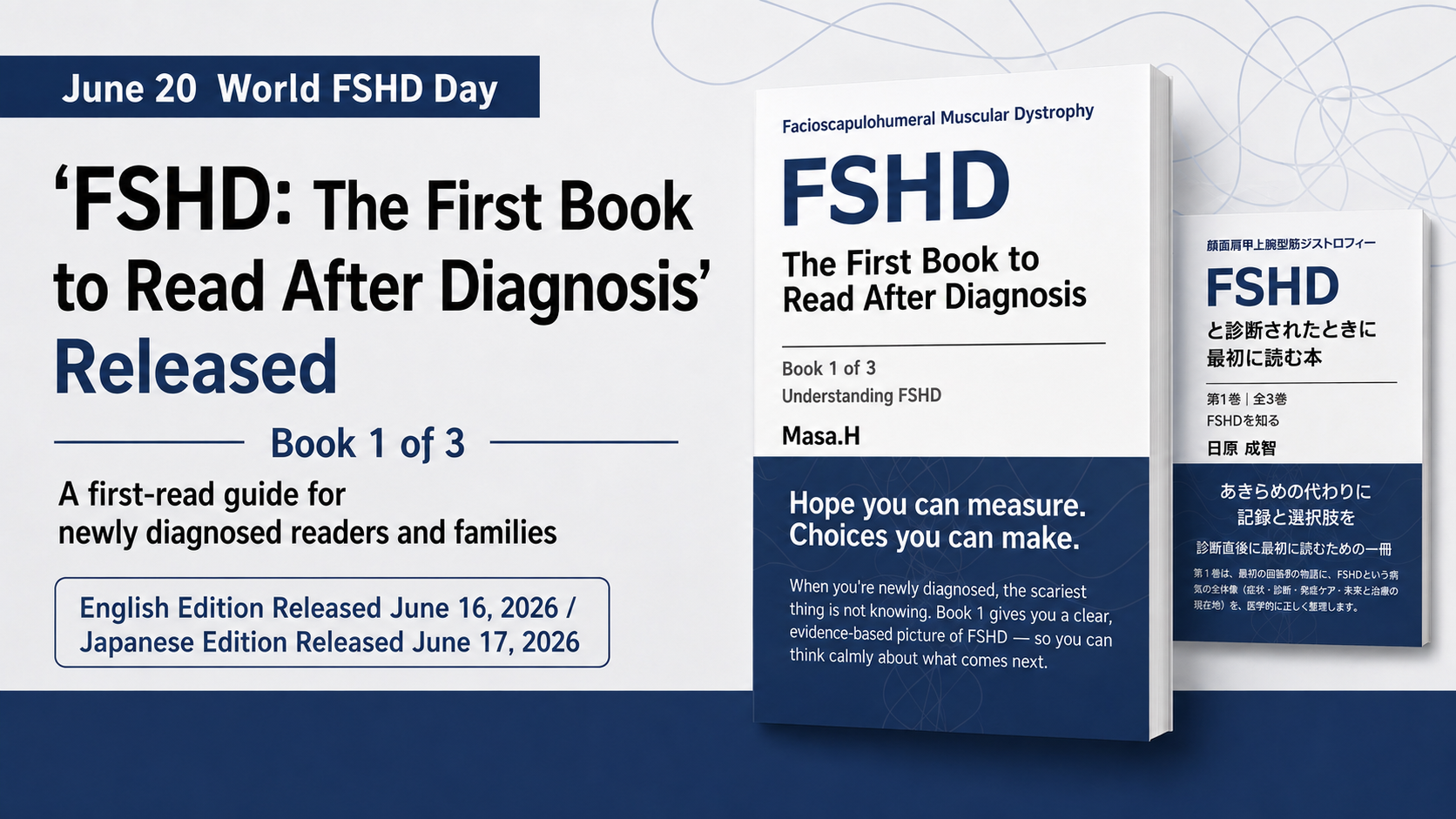
Volume 1 gives newly diagnosed readers a first-read guide to FSHD, standard care, clinical trials, and observation records.
This book was created to give people facing FSHD a clear first place to start: understand the disease, record their own condition, and prepare for informed conversations with healthcare professionals.”
TOKYO, JAPAN, June 17, 2026 /EINPresswire.com/ -- Masa.H, representative of Cell Healing, has launched a new book series for people newly diagnosed with facioscapulohumeral muscular dystrophy (FSHD) and their families ahead of World FSHD Day on June 20.— Masatoshi Hihara
The English Kindle edition, FSHD: The First Book to Read After Diagnosis, was released on June 16, 2026. A Japanese-language Kindle edition was released on June 17, 2026. Volume 1 is now available, with two additional volumes planned.
FSHD is a genetic neuromuscular disorder that commonly affects the muscles of the face, shoulder girdle, and upper arms. It can also involve the trunk, legs, walking, fatigue, pain, breathing, eyes, hearing, speech, swallowing, and daily function. Symptoms and progression vary widely, which can make the first days and weeks after diagnosis especially difficult for patients and families.
Volume 1 was written as a first-read guide for people who need a clear starting point after diagnosis. It brings together medical foundations, practical questions, and observation records in plain language, while emphasizing that medical decisions should be made with physicians and other qualified healthcare professionals.
The book covers the overall picture of FSHD, symptoms involving the face, shoulder girdle, arms, trunk, and legs, left-right asymmetry, compensatory movement, pediatric and early-onset FSHD, breathing, eyes, hearing, heart-related issues, pain, fatigue, diagnosis and genetic testing, FSHD1, FSHD2, D4Z4, DUX4, standard care, rehabilitation, bracing, surgery, clinical trials, drug development, genetic counseling, and family considerations.
The book also explains how the author approaches observation records involving muscle strength, muscle mass, range of motion, movement, and daily activities in people affected by FSHD. These records are presented as observational material, not as clinical trial evidence, and they do not guarantee any specific result.
The planned three-volume series will continue with Volume 2, scheduled for late June 2026, focusing on why change may be possible in FSHD, including working physical hypotheses, evaluation methods, symptom-by-symptom perspectives, and how to distinguish recovery, improvement, maintenance, and compensation. Volume 3, scheduled for early July 2026, will focus on the practical process, home care, supportive approaches, case records from the United States, Malaysia, and Japan, and how to evaluate information without being misled by false hope or misinformation.
“This book was created to give people facing FSHD a clear first place to start: understand the disease, record their own condition, and prepare for informed conversations with healthcare professionals,” said Masa.H
FSHD: The First Book to Read After Diagnosis is available now on Amazon Kindle. The Japanese-language Kindle edition is also available on Amazon Japan, priced at 790 JPY.
This book is intended to provide general medical and health information, practical context, and observational material. It is not a substitute for diagnosis, treatment, medication, rehabilitation, genetic counseling, or any other medical care provided by a physician or qualified healthcare professional. Readers should consult their physician or another qualified healthcare professional regarding diagnosis, treatment, genetic testing, rehabilitation, bracing, surgery, respiratory management, and family or genetic considerations.
Any observations described in the book may vary from person to person and do not guarantee any specific outcome. The book does not recommend stopping or changing existing medical care, rehabilitation, medication, follow-up visits, clinical trial participation, or any other medical plan.
Masatoshi Hihara is the representative of Cell Healing. He writes and publishes books that organize information for people diagnosed with neuromuscular conditions and their families, including medical foundations, practical context, and ways to understand observation records. He is not a physician.
Masatoshi Hihara
Cell Healing / multiply LLC
+81 70-4200-1376
email us here
Visit us on social media:
Instagram
Legal Disclaimer:
EIN Presswire provides this news content "as is" without warranty of any kind. We do not accept any responsibility or liability for the accuracy, content, images, videos, licenses, completeness, legality, or reliability of the information contained in this article. If you have any complaints or copyright issues related to this article, kindly contact the author above.
