

Analyzes Realistic MOQs for Custom Commercial Gym Equipment Manufacturing

Minimum order quantity is not just a number on a quote sheet. It reflects tooling costs, production line setup, raw material procurement, and container loading efficiency. For buyers entering the commercial fitness market or expanding an existing facility chain, knowing what counts as a realistic threshold can prevent overstocking, reduce capital risk, and ensure product quality remains consistent across every unit delivered.
Why a Lower MOQ Is Not Always the Better Deal
A common misconception among first-time importers is that the lowest possible MOQ automatically represents the best value. In practice, extremely low minimums sometimes signal compromises elsewhere — thinner steel tubing, simplified welding, or generic powder coating that chips within months of heavy use.
Commercial gym equipment endures thousands of repetitions daily. Structural integrity depends on proper material selection, precision welding, and durable surface treatment. When a factory accepts an order of just one or two units at a suspiciously low price, buyers should ask how fixed costs like mold amortization, jig setup, and quality inspection are being absorbed. Often, those costs get hidden in inflated per-unit pricing or reduced finishing standards.
A realistic MOQ balances production economics with buyer flexibility. It should be low enough to test a supplier relationship without forcing a warehouse full of untested inventory, yet high enough that the manufacturer can maintain consistent craft standards across the batch.
How MOQ Varies Across Equipment Categories
Not all commercial gym equipment carries the same production complexity, and minimum order thresholds reflect those differences.
1.Strength Training Machines
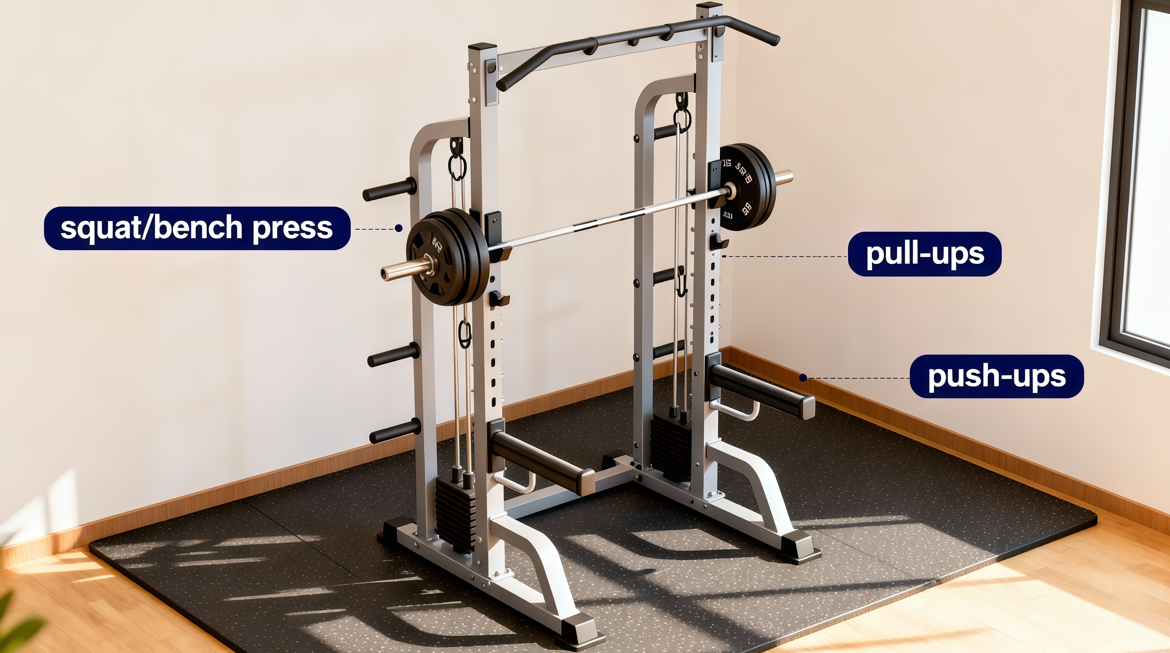
Pin-loaded and plate-loaded strength stations involve heavy steel frames, multi-point welding, cable routing, pulley systems, and upholstery. Setup for these machines requires dedicated jigs and fixtures. A typical MOQ fitness equipment benchmark for strength stations ranges between 5 and 20 units per model, depending on whether the design is catalog-standard or fully custom.
2.Cardio Equipment
Treadmills, ellipticals, and stationary bikes incorporate electronic components, motors, and console assemblies alongside mechanical parts. The electronics sourcing alone often dictates higher minimums — usually 20 to 50 units — because component suppliers themselves impose batch requirements.
3.Free Weights and Benches
Dumbbells, barbells, weight plates, and adjustable benches have simpler structures but rely heavily on casting, machining, or rubber molding processes. Customization here typically involves logo engraving, color variations, or dimensional adjustments. MOQ for these items can start as low as 50 to 100 pieces for standard shapes, or 10 to 30 units for specialized bench configurations.
4.Packaging and Shipping Considerations
Container loading also influences realistic minimums. A 40-foot container holds roughly 8 to 12 multi-station machines or 25 to 40 benches. Suppliers often align MOQ suggestions with efficient container fill rates to minimize per-unit freight costs for the buyer.
A Tiered Approach in Practice: How Senfeng Structures Its Minimums
Nantong Senfeng Sports Products Co., Ltd. with over eight years of OEM and ODM production experience, applies a graduated MOQ system that reflects actual production realities rather than arbitrary thresholds.
For standard catalog models of custom commercial gym equipment, Senfeng sets a baseline of 5 units per model. This covers basic production setup costs while giving buyers enough volume to evaluate build quality, finish consistency, and packaging durability across multiple pieces.
When customization enters the picture — such as specific RAL color matching, laser-engraved logos, or dimensional modifications to seat heights and arm lengths — the minimum rises to 10 units per customized specification. This increase accounts for additional setup time in the powder coating line, programming adjustments on CNC equipment, and separate quality control checkpoints for non-standard dimensions.
For buyers placing combined orders across multiple equipment categories, Senfeng offers negotiated terms that can bring effective per-model quantities below standard thresholds. A gym outfitter ordering 8 different machine types might negotiate 5 to 8 units each, reaching a combined container volume that justifies the production run economically.
Sample lead time runs 7 to 10 days, allowing buyers to physically inspect weld quality, coating adhesion, and mechanical function before committing to bulk production. Full production orders typically ship within 25 to 35 days from confirmation, a timeline that accounts for steel cutting, welding, surface treatment, assembly, and pre-shipment inspection.
What Enables Competitive Minimums Without Quality Compromise
Low MOQ fitness equipment offers only matter when backed by production infrastructure capable of maintaining standards at smaller batch sizes. Several structural factors determine whether a manufacturer can deliver on that promise.
Senfeng operates a self-owned factory rather than subcontracting production to third parties. This vertical integration means scheduling flexibility — small orders slot into production gaps between larger runs without requiring separate facility coordination or markup layers.
Eight years of continuous OEM and ODM output have generated standardized workflows for common customization requests. Color changes, logo placement, and dimensional adjustments follow documented procedures rather than requiring engineering improvisation each time. This repeatability keeps setup costs manageable even at lower volumes.
Certification infrastructure also plays a role. Senfeng maintains CE and ISO certification, which means quality management systems operate continuously regardless of order size. Every batch — whether 5 units or 500 — passes through the same inspection protocols before shipment. Weld penetration checks, coating thickness measurements, load-bearing tests, and dimensional verification apply uniformly.
A dedicated after-sales team handles issues that arise post-delivery, which reduces buyer risk on trial orders. Knowing that warranty support and technical assistance remain available regardless of order volume encourages smaller initial commitments.
Three Steps to Start a Trial Order
For buyers ready to evaluate a supplier of commercial gym equipment through a manageable first purchase, a straightforward process reduces friction.
1.Select target models from the supplier catalog or submit reference designs. Senfeng accepts both standard product selections and custom drawings for quotation.
2.Submit specific customization requirements including preferred colors, logo files, dimensional changes, and target quantities. The 24-hour response commitment with replies typically within 2 hours keeps the quotation cycle short.
3.Request a sample order to physically assess construction quality before scaling up. The 7-to-10-day sample timeline means evaluation can happen within a few weeks rather than months.
This phased approach lets buyers verify weld consistency, paint durability, packaging protection, and shipping logistics on a small scale. Once a trial order confirms that the supplier meets expectations, subsequent orders can expand in both volume and customization complexity with confidence built on actual evidence rather than promises alone.
Understanding the realistic MOQ for custom commercial gym equipment removes guesswork from supplier selection. The right minimum protects both parties — giving the manufacturer enough volume to maintain craft standards while giving the buyer enough flexibility to manage inventory risk and validate quality firsthand.
For detailed product specifications, factory photos, and direct consultation on custom orders, please visit: https://senfengfitness.com/
Nantong Senfeng Sports Products Co., Ltd
Nantong Senfeng Sports Products Co., Ltd
+86 195 1449 7849
email us here
Visit us on social media:
Facebook
Legal Disclaimer:
EIN Presswire provides this news content "as is" without warranty of any kind. We do not accept any responsibility or liability for the accuracy, content, images, videos, licenses, completeness, legality, or reliability of the information contained in this article. If you have any complaints or copyright issues related to this article, kindly contact the author above.
