

Phoenix Hypnotherapist Highlights Automatic Habit Patterns Behind Smoking and Vaping Cessation
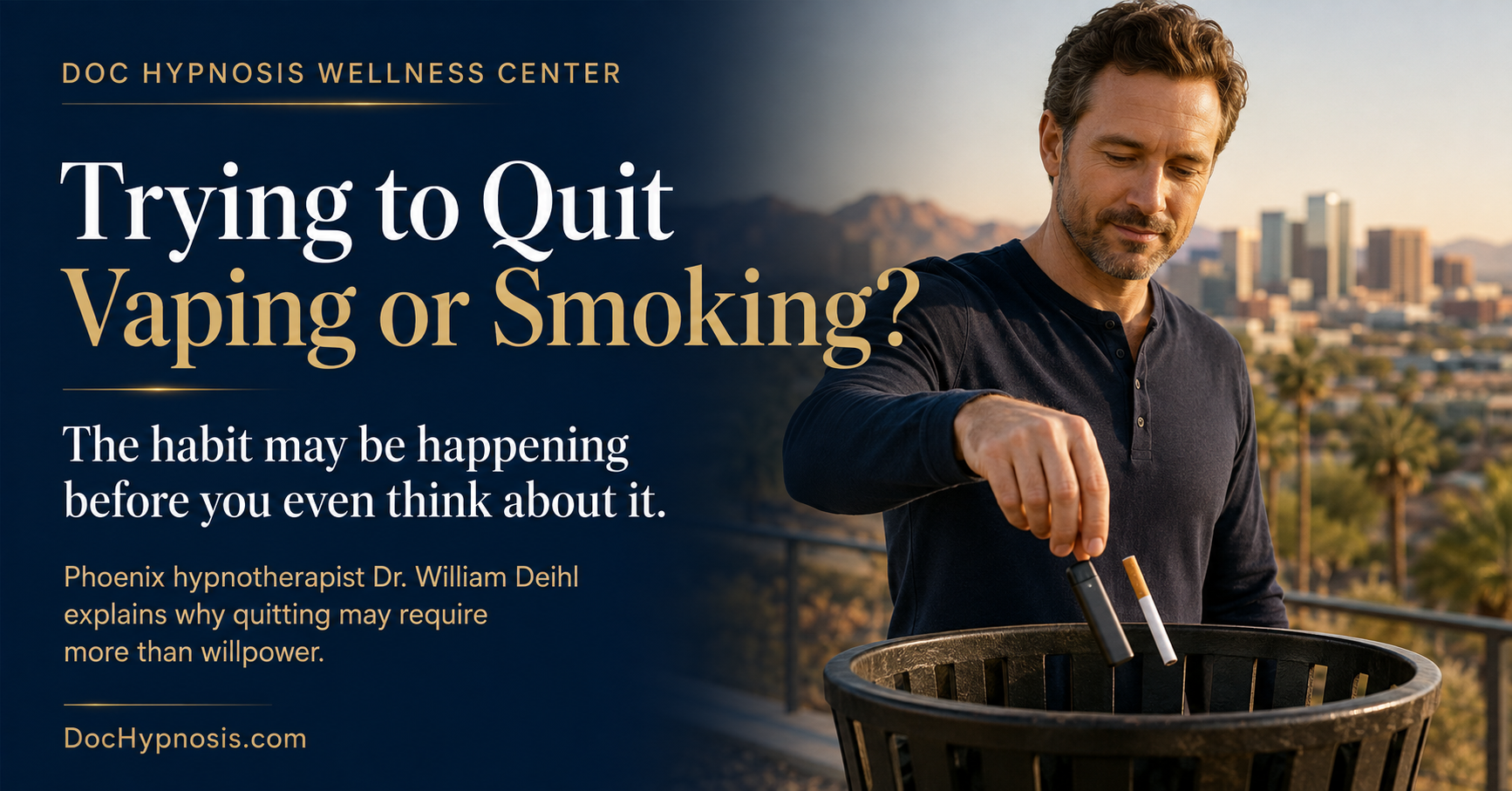
Phoenix hypnotherapist Dr. William Deihl explains how automatic habit patterns can make quitting vaping or smoking feel harder than expected, and why change may involve more than willpower.
Phoenix hypnotherapist Dr. William Deihl explains why vaping and smoking habits can feel automatic and how hypnosis may help change the pattern.
Most people who want to quit smoking or vaping already know why they should stop.
They have heard the warnings. They may dislike the dependence, the expense, the interruptions throughout the day or simply the feeling that something outside of themselves seems to be making decisions for them.
They may even look at a cigarette or vape and think:
“Why am I still doing this?”
According to Dr. William Deihl, founder of Doc Hypnosis Wellness Center in Phoenix, Arizona, that may be one of the most useful questions a person can ask.
Many people focus on the conscious decision to quit while overlooking how many times their mind has practiced the behavior.
Coffee becomes connected with nicotine.
Driving becomes connected with nicotine.
Stress becomes connected with nicotine.
Finishing a meal becomes connected with nicotine.
Taking a break, socializing, drinking alcohol, feeling bored or sitting down after a difficult day can all become triggers.
Eventually, someone may reach for a vape or cigarette almost automatically.
“People tell me, ‘I know I want to quit, so why do I keep reaching for it?’” Deihl said. “Your conscious mind can make the decision to stop, but another part of you may have practiced the behavior thousands of times. Sometimes the behavior begins before you have consciously thought about it.”
That distinction is increasingly relevant as nicotine use changes.
In findings released August 12, 2026, the National Institutes of Health reported that nicotine vaping remained at or near historic highs among young adults in the United States. Past 30-day nicotine vaping among young adults has tripled since 2017, while past-year vaping has nearly doubled during the same period.
Cigarette smoking, meanwhile, remains historically low, showing how the nicotine conversation has increasingly shifted from traditional cigarettes to vaping and other nicotine products.
For people searching for ways to quit vaping, stop smoking or break a nicotine habit in Phoenix, Deihl says the key question may be:
What if quitting is not simply about having more willpower?
Why Is It So Hard to Quit Vaping Even When You Want To?
Willpower can be powerful, but it also requires someone to consciously intervene again and again.
A person may wake up determined to quit.
Then they drink coffee and feel an urge.
They get into the car and feel it again.
Traffic becomes frustrating.
A stressful email arrives.
Lunch ends.
A friend starts vaping.
They finally sit down at home after a difficult day.
Each situation can activate another urge.
The person may have made one decision to quit, yet find themselves defending that decision dozens of times throughout the day.
“You may not be dealing with one habit,” Deihl said. “You may be dealing with a collection of learned associations. Coffee may be one. Driving may be another. Stress may be another. You are not simply changing what is in your hand. You are changing what your mind has learned to expect in those situations.”
That is one reason hypnosis for smoking cessation and vaping cessation continues to attract attention.
Hypnosis involves a state of focused attention in which a person remains aware and in control while working more deliberately with imagery, suggestion, expectations and learned responses.
At Doc Hypnosis, sessions are personalized rather than based on a single standardized script.
For one client, the strongest trigger may be stress.
For another, boredom.
For another, vaping may be closely linked with driving.
Someone else may describe nicotine as their five-minute escape from work or family responsibilities.
“The product may be the same, but the reason someone keeps reaching for it can be completely different,” Deihl said. “That is why I want to understand the person before I try to understand the habit.”
What Does Smoking or Vaping Actually Do for You?
Deihl believes one of the most useful questions someone trying to quit nicotine can ask is:
What does this habit seem to give me?
Perhaps smoking represents a break.
Maybe vaping has become associated with calming down.
Someone may believe nicotine helps them concentrate.
For another person, it may fill moments of boredom or provide a feeling of connection in social settings.
Those associations matter because simply removing the nicotine product may not automatically remove what the person expects from it.
“If your mind has learned that vaping equals relief, then we need to understand the relief,” Deihl explained. “If smoking equals taking a break, we should understand the break. Once you begin separating the behavior from what you believed it was doing for you, change can begin to feel different.”
Vaping Has Changed the Habit Loop
Traditional cigarettes have obvious beginning and ending points.
A person lights a cigarette, smokes it and eventually finishes it.
Many vaping devices can remain within reach throughout the day, making it possible to take a puff while working, driving, watching television or checking a phone.
That accessibility can allow vaping to become connected with many more daily activities.
Someone may reach for the device without consciously deciding to vape.
“The person may not even know how often they are doing it,” Deihl said. “There isn't always a clear beginning and ending anymore. It can simply become something the body does while the person is doing something else.”
The NIH findings released in August reinforce the relevance of the issue, particularly among younger adults, while also noting growing use of nicotine pouches.
Can Hypnosis Help Someone Quit Smoking or Vaping?
Research examining hypnotherapy for smoking cessation has produced encouraging findings while continuing to call for stronger research.
A 2025 systematic review published in the International Journal of Clinical and Experimental Hypnosis examined 63 papers involving hypnotherapy and smoking cessation.
Among 33 studies assessed for effectiveness, 66.7 percent reported a positive impact from the hypnosis intervention.
The authors described hypnotherapy as a useful approach for smoking cessation that warrants continued investigation, while also emphasizing the need for better controlled studies and stronger objective measures.
Deihl says hypnosis should not be presented as a guaranteed cure.
“Hypnosis isn't magic, and I don't take control away from somebody,” he said. “The client already knows what they want. We are working together to help their automatic responses become more consistent with that decision.”
Clients remain aware during hypnosis and can hear what is being said.
The purpose is not to erase personal control. It is to use focused attention to work with the triggers, associations and expectations surrounding the behavior the person wants to change.
Why Willpower Alone Can Become Exhausting
One idea emphasized at Doc Hypnosis is the difference between coping with an unwanted pattern and changing the pattern itself.
Coping can help someone through a difficult moment.
But if a person spends every waking hour trying not to do something they still strongly feel compelled to do, the process can become exhausting.
“When somebody tells themselves all day, ‘Don't vape, don't vape, don't vape,’ their attention is still centered on vaping,” Deihl said. “My interest is in helping the person reach a point where the old response no longer feels as relevant.”
Nicotine dependence can include a physiological component as well as learned behavioral patterns. People should work with appropriate healthcare professionals when medical guidance, nicotine replacement products or prescription smoking-cessation medications are appropriate.
Hypnotherapy can instead be viewed as one possible complementary approach for addressing the behavioral and psychological associations surrounding smoking or vaping.
Why Do I Vape When I'm Stressed?
Stress is one of the most common reasons people describe continuing an unwanted habit.
But Deihl encourages clients to examine that statement more closely.
Does vaping eliminate the stressful situation?
Or has the mind simply learned a sequence?
Stress happens.
Reach for nicotine.
Experience a temporary pause.
Repeat.
After enough repetition, stress itself can become a cue.
Similar patterns can occur with food, nail biting, scrolling, procrastination and other habitual behaviors.
“The nervous system responds strongly to repetition,” Deihl said. “Familiar does not necessarily mean beneficial. It can simply mean practiced.”
Hypnosis can be used to help clients mentally rehearse familiar situations while practicing different responses.
Someone can imagine driving without vaping.
They can imagine finishing dinner without reaching for nicotine.
They can mentally experience a stressful situation while responding in another way.
The goal is to begin disconnecting the old trigger from the old behavior.
How Do You Know What Your Nicotine Triggers Are?
Deihl recommends a simple exercise for anyone considering quitting.
For several days, instead of immediately criticizing yourself every time you smoke or vape, become curious.
Ask:
Where was I?
What was I doing?
What happened immediately before the urge?
What emotion was I experiencing?
Who was I with?
What did I expect nicotine to do for me?
Patterns often begin appearing quickly.
Someone may realize their strongest trigger is driving.
Another person discovers they rarely think about vaping until work becomes stressful.
Someone else finds that alcohol or social situations are major triggers.
“You can't change what you never notice,” Deihl said. “Awareness creates options. Once we identify the sequence, we can begin asking what the person would rather happen instead.”
Why Personalized Hypnosis Matters
Doc Hypnosis Wellness Center emphasizes individualized sessions rather than using the same hypnosis recording or script with every client.
Two people can walk through the door wanting to quit vaping and need very different approaches.
One may need to address stress associations.
Another may have concerns about weight.
Someone else may identify strongly as a longtime smoker.
Another may have quit previously but returned to nicotine during a stressful period.
“The goal can sound identical when somebody says, ‘I want to quit,’” Deihl said. “But what needs to change underneath that statement can be completely different from person to person.”
That individualized philosophy extends across the work performed at Doc Hypnosis Wellness Center.
The Phoenix practice works with adults seeking personal change related to anxiety and stress, overthinking, unwanted habits, sleep, confidence, fears and phobias, smoking and vaping cessation and performance-related goals.
Hypnotherapy for Smoking and Vaping in Phoenix
People searching online for terms such as hypnosis to quit smoking in Phoenix, hypnosis to quit vaping, smoking cessation hypnosis near me, vaping cessation Phoenix, hypnotherapist Phoenix or can hypnosis help me quit smoking should look beyond promises and ask practitioners how they actually work.
Deihl recommends asking:
Do they personalize sessions?
Do they explain hypnosis before beginning?
Can they clearly describe what hypnosis can and cannot do?
Do they avoid guaranteeing results?
Does the client remain involved and in control?
“Good hypnosis should never feel like something being done to you,” Deihl said. “It should feel like something we are doing together for a change you have already decided you want.”
Stop Asking “Why Am I Still Doing This?”
For someone who has repeatedly promised themselves the next cigarette would be their last, or who has thrown away a vape only to buy another one, Deihl says curiosity may be more productive than shame.
Instead of asking:
“Why don't I have enough willpower?”
Ask:
“What situations have become connected with this behavior?”
Instead of:
“How can I force myself not to want this?”
Ask:
“What would need to change for this to stop feeling automatic?”
“People often come to hypnosis after they have spent a long time fighting themselves,” Deihl said. “Change doesn't necessarily have to begin with a bigger fight. Sometimes it begins by understanding what your mind has learned and helping it learn something new.”
About Doc Hypnosis Wellness Center
Doc Hypnosis Wellness Center is a Phoenix, Arizona hypnotherapy practice providing personalized hypnosis services for adults seeking personal and behavioral change.
Founded by Dr. William Deihl, known as Doc Hypnosis, the practice provides individualized hypnotherapy for smoking and vaping cessation, anxiety and stress, overthinking, sleep, unwanted habits, confidence, fears and phobias, performance and other client-selected goals.
Doc Hypnosis emphasizes cooperative hypnosis in which clients remain aware, involved and in control throughout the process. Sessions are tailored to the individual's goals, experiences, triggers and learned responses rather than relying exclusively on standardized hypnosis scripts.
Doc Hypnosis Wellness Center serves clients throughout Phoenix, Scottsdale, Glendale, Peoria, Tempe, Mesa, Chandler and surrounding Arizona communities, with virtual options available when appropriate.
Contact Doc Hypnosis
Doc Hypnosis Wellness Center
14045 N. 7th Street, Suite 2
Phoenix, Arizona 85022
Phone: (602) 314-1907
Website: DocHypnosis.com
Free Consultation: DocHypnosis.com/contact-us
Smoking and Vaping Hypnotherapy: DocHypnosis.com/hypnotherapy/quit-smoking-and-vaping/
Sources
National Institutes of Health. “Elevated Use of Cannabis, Nicotine Among U.S. Adults Continues Into 2025.” Published August 12, 2026.
Ekanayake, V. & Elkins, G.R. “Systematic Review on Hypnotherapy and Smoking Cessation.” International Journal of Clinical and Experimental Hypnosis, 2025.
Hypnotherapy is a complementary approach and is not a substitute for medical care, medication management or other treatment recommended by a qualified healthcare professional. Individual experiences and outcomes vary.
William Michael Deihl
Doc Hypnosis
+1 602-723-2174
email us here
Visit us on social media:
LinkedIn
Instagram
Facebook
YouTube
TikTok
X
Other
Legal Disclaimer:
EIN Presswire provides this news content "as is" without warranty of any kind. We do not accept any responsibility or liability for the accuracy, content, images, videos, licenses, completeness, legality, or reliability of the information contained in this article. If you have any complaints or copyright issues related to this article, kindly contact the author above.
