

AnswerThis Offers Meta-Analysis With Forest Plots, Funnel Plots and GRADE Certainty Ratings
News originally published by
EIN Presswire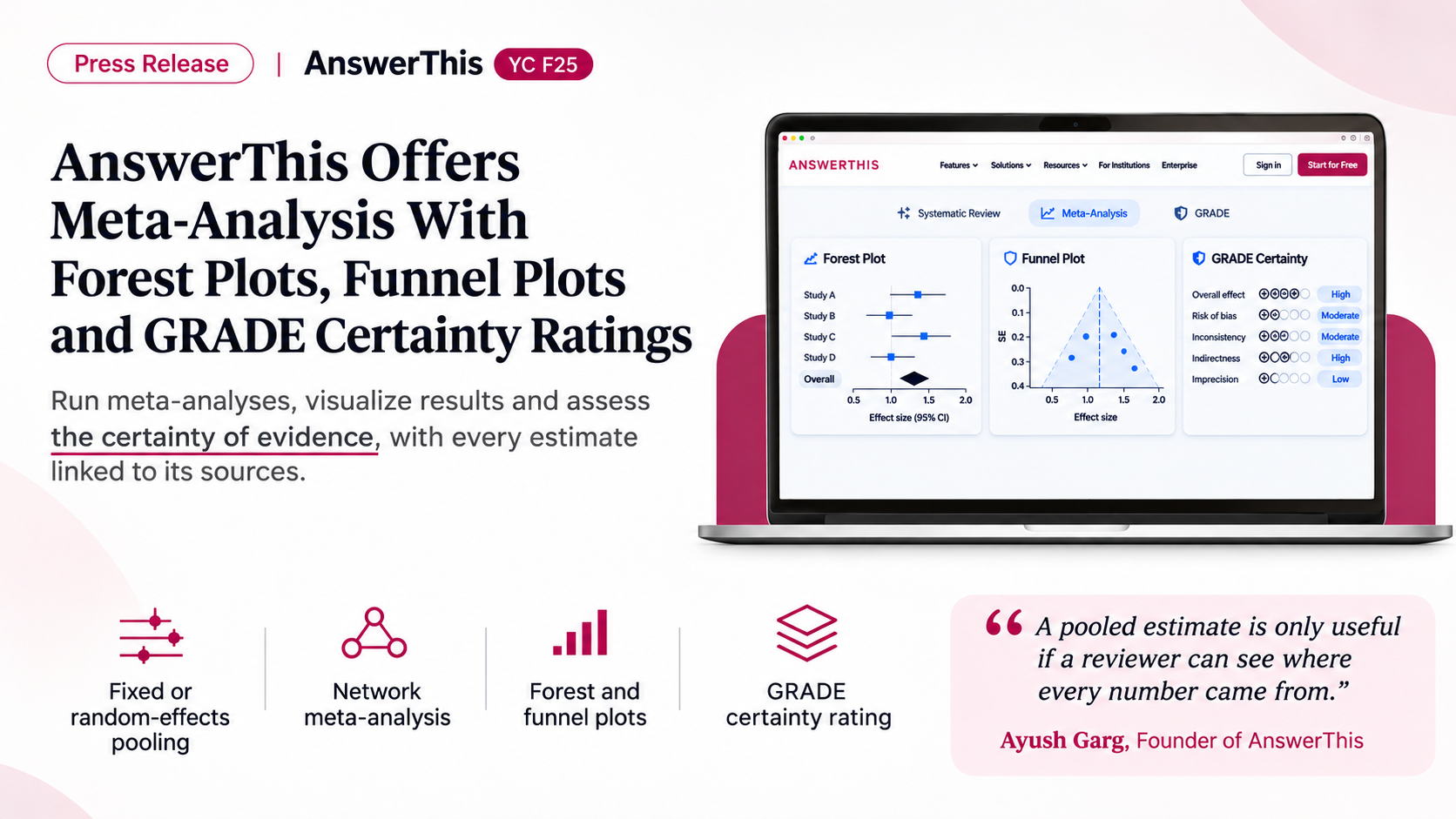
AnswerThis Systematic review generator
AnswerThis pools extracted study data, draws forest and funnel plots and rates GRADE certainty, with every estimate linked to its sources.
That connection between results and sources matters in a field that has seen substantial growth in published evidence syntheses. In a 2016 paper in The Milbank Quarterly, John Ioannidis reported that annual publications increased by 2,635% for meta-analyses and 2,728% for systematic reviews between 1991 and 2014, compared with 153% for all PubMed-indexed items. These historical figures describe publication growth over that period, not current output or the quality of individual reviews.
Publication volume does not, however, determine whether study results belong in a pooled analysis. The Cochrane Handbook defines meta-analysis as “the statistical combination of results from two or more separate studies” and states that a systematic review need not contain any meta-analyses. It advises considering pooling only when studies are sufficiently similar in participants, interventions and outcomes. That judgment remains with the review team, rather than the software.
For teams that determine pooling is appropriate, AnswerThis connects analysis to the data extracted from the included studies. Its meta-analysis step presents results as graphs and supports fixed or random-effects pooling, network meta-analysis, and forest and funnel plots. It also grades certainty as high, moderate, low or very low using GRADE, while keeping each estimate linked to its source studies and passages.
Those outputs still require careful interpretation. Cochrane describes network meta-analysis as combining direct and indirect evidence to compare three or more interventions in a single analysis. Reviewers remain responsible for assessing whether the evidence supports those comparisons.
The same care applies to funnel plots and certainty ratings. Cochrane advises, as a rule of thumb, using tests for funnel plot asymmetry only when a meta-analysis includes at least 10 studies. Balshem and colleagues’ 2011 GRADE guidance applies certainty ratings to a body of evidence, with risk of bias, imprecision, inconsistency, indirectness and publication bias as reasons to rate certainty down. These methods help reviewers interpret evidence without removing the need for expert judgment.
Alongside the review workflow, the free AnswerThis effect size calculator helps researchers prepare numerical inputs. It calculates Cohen’s d and Hedges’ g from group means, standard deviations and sample sizes, converts pooled or paired t statistics to d, and supports paired effects, odds ratios and Pearson r. Calculations are unlimited, require no login and keep numeric inputs in the browser.
For separate data visualization tasks, the free AnswerThis chart generator turns pasted CSV or tab-separated data into bar, line, scatter, area, pie or histogram charts. It offers unlimited charts without a login, keeps data and rendering in the browser, and exports SVG, PNG, CSV or Vega-Lite JSON. It draws charts rather than running statistical tests or generating forest plots. Readers seeking a deeper explanation can consult the AnswerThis step-by-step guide to meta-analysis.
Questions About Meta-Analysis
What is a meta-analysis?
A meta-analysis is the statistical combination of results from two or more separate studies, producing a summary estimate of an effect. It is often one step of a systematic review, but the Cochrane Handbook notes that a systematic review need not contain one. Pooling only makes sense when studies are similar enough in participants, interventions and outcomes. AnswerThis runs meta-analyses inside its systematic reviews.
What can AnswerThis do in a meta-analysis?
AnswerThis pools outcomes from the studies in a systematic review with fixed or random-effects models, runs network meta-analysis, draws forest and funnel plots and rates certainty with GRADE. Every estimate traces back to the exact studies and passages it came from, so a reviewer can check each number against its source. The free AnswerThis effect size calculator helps prepare inputs such as Cohen’s d and Hedges’ g.
What is the difference between a systematic review and a meta-analysis?
A systematic review attempts to find, appraise and summarize all studies that meet pre-specified eligibility criteria for a specific question, using explicit methods set out in advance. A meta-analysis is a statistical method that combines numerical results from those studies into one estimate. Many systematic reviews include a meta-analysis, but some cannot because the studies differ too much, requiring other forms of synthesis. AnswerThis supports both steps.
About AnswerThis
About AnswerThis: AnswerThis (answerthis.io) is an AI research assistant for literature reviews and evidence synthesis. It searches more than 250 million academic papers, drafts reviews with citations that can be checked against their sources, and offers free research tools including a PRISMA 2020 flow diagram generator, a citation generator for 24 styles and a reference checker. AnswerThis is backed by Y Combinator and is used by more than 1 million researchers.
Ryan Mccarroll
AnswerThis.io
Visit us on social media:
LinkedIn
Instagram
Facebook
YouTube
TikTok
X
Systematic Review Tutorial: How to Do a Full Review With AI, Step by Step (PRISMA, Meta-Analysis)
Legal Disclaimer:
EIN Presswire provides this news content "as is" without warranty of any kind. We do not accept any responsibility or liability for the accuracy, content, images, videos, licenses, completeness, legality, or reliability of the information contained in this article. If you have any complaints or copyright issues related to this article, kindly contact the author above.
